How Much Silicon Carbide Do You Actually Need in a Lava Glaze?
There's a popular belief floating around glaze circles: the more silicon carbide you add to a lava glaze, the more bubbles and craters you'll get. It sounds logical. It's also not quite true — and this glaze review is my attempt to put that rumor to rest.
This is a two-set comparison from recent workshops — one in Lebanon, one in Portugal — both testing the same variable: what happens to a lava glaze as you increase the amount of silicon carbide, step by step, from 1% up to 8%.
What Silicon Carbide Actually Does in a Glaze
Silicon carbide (SiC) is a man-made material — a dark grey, almost black powder — that's the real engine behind that classic volcanic, cratered lava glaze surface. When it's added to a glaze, it reacts with the other ingredients and releases carbon monoxide and carbon dioxide as it melts. Those gases get trapped in the glaze and leave craters behind as they escape: sometimes tiny, leaving a puffy texture, and sometimes large, leaving the dramatic moon-like bubbles people associate with lava glaze.
What it doesn't do in a simple linear way is scale up bubbles in proportion to how much you add. That's exactly what these two test sets show.
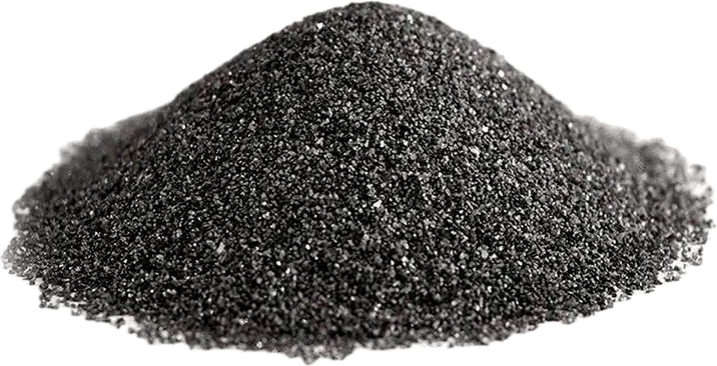
Silicon Carbide
Two Test Sets: What Changing the SiC Amount Actually Does
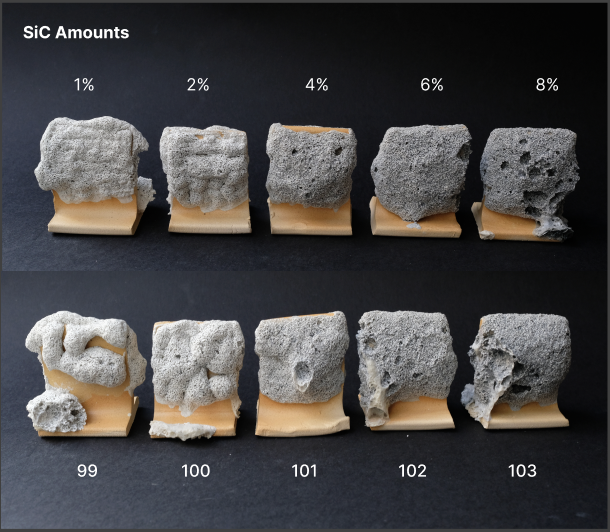
Test Set 1 — Lebanon Workshop: The Gray Progression
This set ran the same glaze across five SiC percentages — 1%, 2%, 4%, 6%, and 8% — to isolate exactly one variable. The result wasn't more bubbles as the percentage climbed. It was more gray. As the SiC amount increases, the test tile gets visibly grayer and grayer, because once you go past a certain point, the silicon carbide simply stops fully reacting — the unreacted particles just sit in the glaze and tint it toward their own natural grey-black color. If you're after a whiter lava surface, the takeaway is almost counterintuitive: use less silicon carbide than you'd assume, not more.
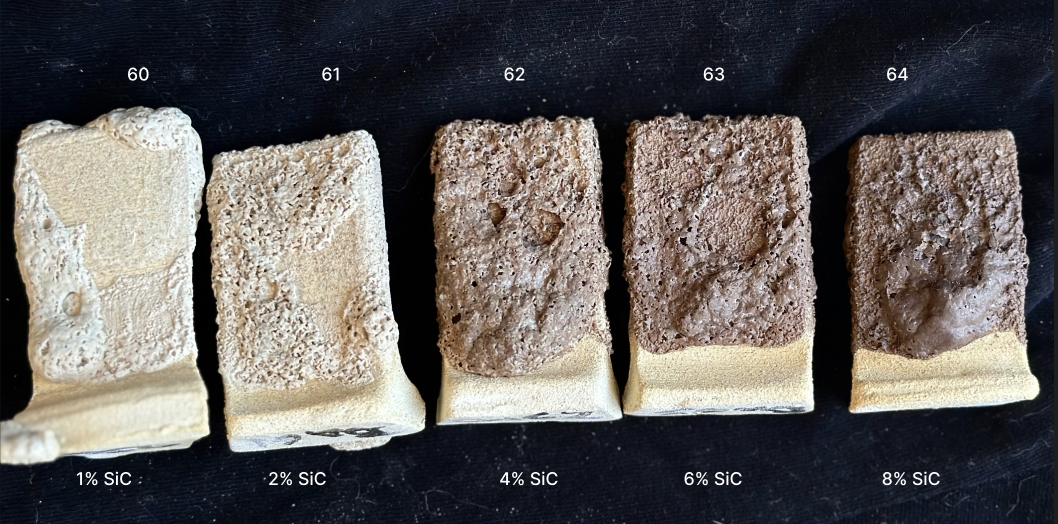
Test Set 2 — Portugal Workshop: The Brown Surprise
This set ran the same percentage progression — 1% through 8% — but with a completely different result: the tiles got progressively browner as the SiC percentage went up. This one genuinely surprised me. It's possible the brown is coming from titanium dioxide or rutile-related contaminants in the local Portuguese materials, it's possible it's the silicon carbide itself, and it's most likely some combination of both — unmelted SiC particles behaving the same way they did in the Lebanon set, just interacting with a different base material and producing a different tint entirely.
Both sets point to the same underlying mechanism: once you add more silicon carbide than the glaze has the strength to fully melt, the leftover particles stop being a texture-maker and start being a colorant.
So… How Much Should You Actually Use?
Based on these tests and what I've seen across dozens of workshop recipes (including the ones that circulate on resources like Glazy.org), the sweet spot is much smaller than people expect — typically somewhere in the 0.5% to 2.5% range. Even a fraction of a percent is often enough to generate real lava texture. Past that, you're not buying more drama — you're buying more unreacted material sitting in your glaze, changing its color in ways you didn't plan for.
I keep the full numbers, the specific recipes behind these test sets, and the rest of my glaze test library on Patreon — about 20–40 recipes a month, for $15/month, if you want the actual figures rather than the principles.
Who Are These Glaze Textures For?
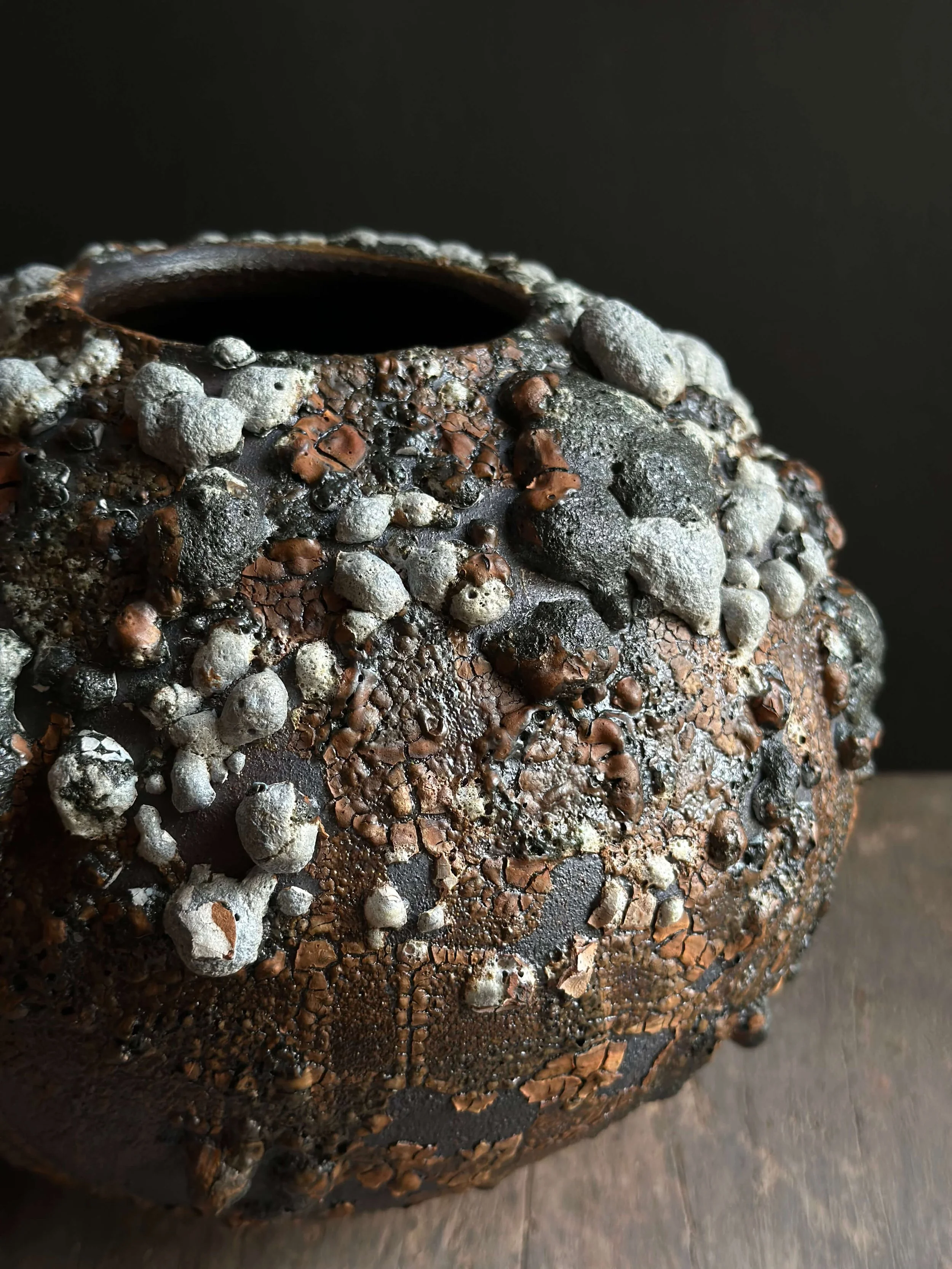
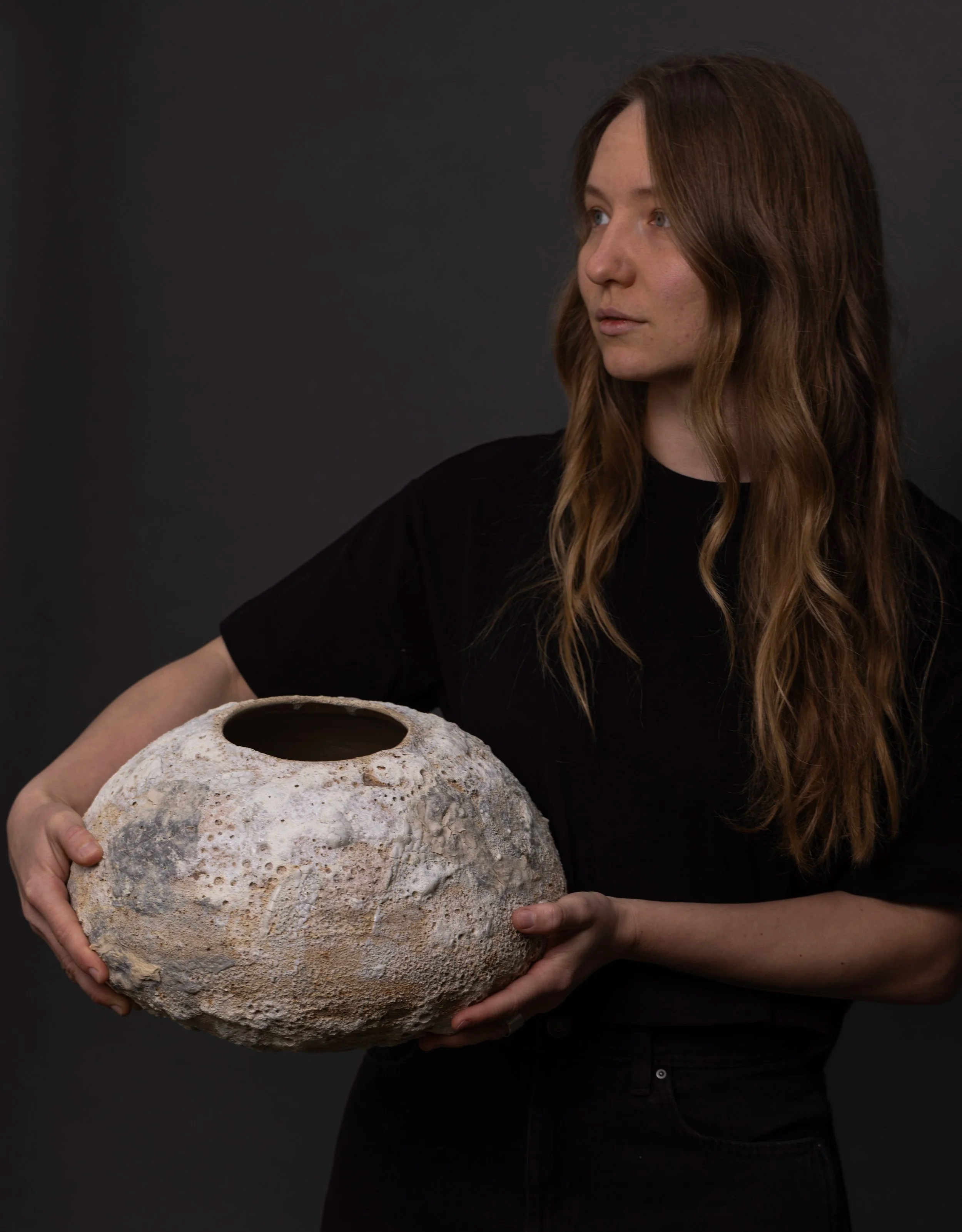
Ceramic textured vessel by Maria Loram
These are decorative glaze surfaces — not functional ones. Crawl glazes and underfired special effect glazes are porous and not food-safe. But for decorative ceramics — sculptures, textured ceramic vases, wall pieces, wabi-sabi pottery, art objects with organic pottery surfaces — they open up territory that a well-fired glossy glaze never reaches.
The earthy, nature-inspired ceramic aesthetic that so many makers are drawn to right now — rough surfaces that look like volcanic rock or weathered stone — often comes from exactly this kind of deliberate underfiring and thick application. It's not an accident. It's a technique.
Want to Learn How to Create Special Effect Glazes?
I don't share full recipes in this post — partly because glaze results depend so much on your specific kiln, clay body, and firing temperature, and partly because I think the method matters more than the recipe.
If you want to go deeper:
The Glaze is Lava is my dedicated online course on lava glaze, crater glaze, and silicon carbide-based special effect glazes. It covers the variables that change results — SiC mesh size, flux ratios, application, troubleshooting — so you understand why glazes behave the way they do, not just what to mix.
Textures in Ceramics is a broader 8-week online course covering ceramic texture techniques from natural materials (slips, rocks, sand, combustibles) through to textured and lava glazes. It's the right starting point if you want to develop a whole vocabulary of ceramic surface decoration.
And if you're specifically after glaze recipes and test results — including my monthly experiments — I post those on my Patreon.
What textures are you experimenting with right now? I'd love to know — send me an email or find me on Instagram.
About the Author
Hi, I’m Maria — a ceramic artist based in the US. I make sculptural lighting and hand-built vessels, and I share my studio process online.
I teach ceramics internationally and online. → loramceramics.com
This checklist is part of a growing library of free guides for ceramic artists and makers.