How Silicon Carbide Mesh Size Controls Lava Glaze Texture (From Rough to Smooth)
Most ceramicists working with lava glazes focus almost entirely on the recipe — which flux, how much silicon carbide, what cone. But there's a variable that can take that exact same recipe and produce completely different results: the mesh size of your silicon carbide.
Too coarse, and the particles are simply too large to react with the glaze. Too fine, and you lose the rough, bubbly texture that makes lava glazes so distinctive in the first place. In between those two extremes is a range of results — from wildly rough and craterlike to smooth and delicately bubbly — all from a single variable that most tutorials don't mention at all.
I tested the full range during an intensive in Lisbon: tiles 65 through 69, each with the same base glaze and the same amount of silicon carbide, differing only in particle size. Here's what I found.
What Silicon Carbide Actually Does in a Glaze
Silicon carbide (SiC) is a man-made material — a dark grey, almost black powder — that's the real engine behind that classic volcanic, cratered lava glaze surface. When it's added to a glaze, it reacts with the other ingredients and releases carbon monoxide and carbon dioxide as it melts. Those gases get trapped in the glaze and leave craters behind as they escape: sometimes tiny, leaving a puffy texture, and sometimes large, leaving the dramatic moon-like bubbles people associate with lava glaze.
What it doesn't do in a simple linear way is scale up bubbles in proportion to how much you add. That's exactly what these two test sets show.
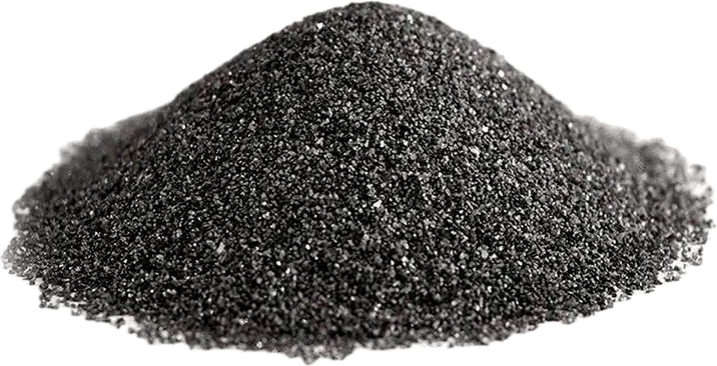
Silicon Carbide
What Mesh Size Actually Means
Mesh size is measured by the number of holes in a sieve per square inch. A small mesh number means large holes — and therefore large particles pass through. A high mesh number means small, fine holes — only fine powder gets through.
So 23 mesh = very coarse, large particles. 1000 mesh = extremely fine powder. The number goes up as the particle gets smaller, which is the opposite of what you might assume. This trips people up constantly, and it's worth making sure it's clear before you read the results below.
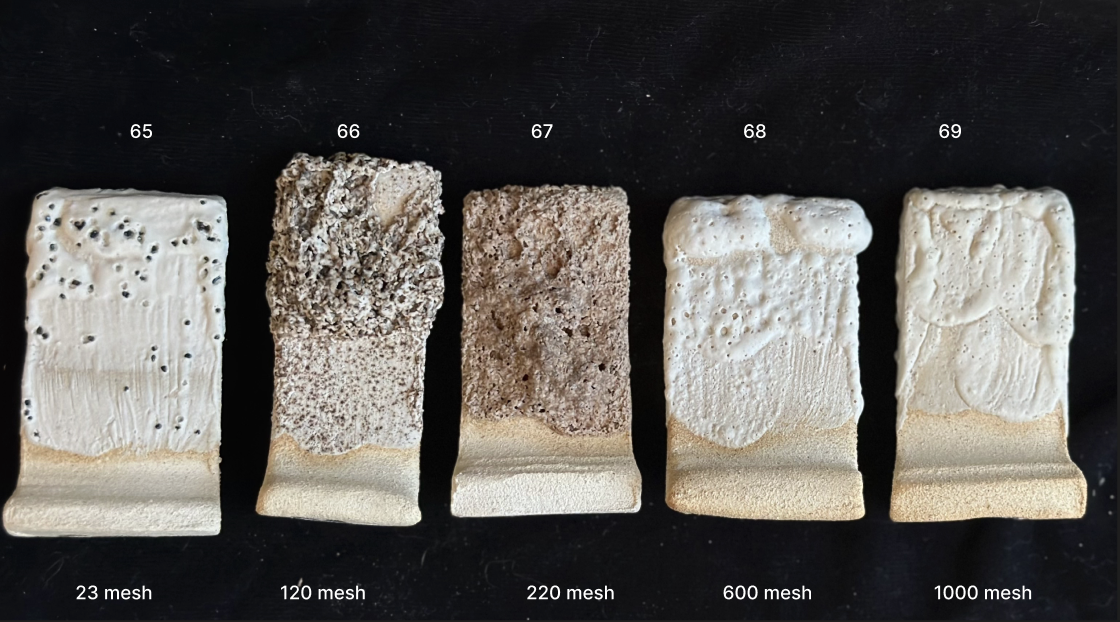
Lava glaze test tiles showing various mesh sizes — ceramic texture experiments, Loram Ceramics workshop Lisbon
The Test: 23 Mesh to 1000 Mesh Side by Side
Tile 65 — 23 Mesh (very coarse) The particles are so large they don't react at all — they sit in the fired glaze completely untouched, exactly as they were in the jar. What you see is speckling, not lava texture. In the broader 20–75 mesh range you'll occasionally see a small amount of puffiness, but very often nothing happens.
Tiles 66 and 67 — 120 and 220 Mesh (the sweet spot) This is where lava glazes really come alive. Both tiles show aggressive, rough texture — heavy bubbling, pronounced craters, dramatic surface movement. The 100–230 mesh range produces the classic lava effect: coarse, rough, full of energy. These tiles also came out a warm brown rather than the usual gray, which I suspect is coming from the specific German silicon carbide used — a color I loved enough that I'm planning to order it directly.
Tiles 68 and 69 — 600 and 1000 Mesh (fine to ultra-fine) As the particle size gets smaller, the glaze gets whiter again — more silicon carbide is fully melting rather than sitting unreacted in the surface. By 600 mesh the bubbles are noticeably finer and the texture more restrained. By 1000 mesh the surface is quite smooth, with small delicate bubbles and a light, clean appearance. A different aesthetic from the 120–220 range, but not a worse one.
What This Means for Your Practice
The golden middle for classic lava texture is somewhere in the 100–230 mesh range. Below that, in the coarser particles (roughly 20–75 mesh), you risk getting little to no reaction at all. Above it, the lava gets progressively smoother and the glaze lightens in color as more of the silicon carbide fully melts.
If you've been using a lava glaze recipe and getting disappointing texture — either nothing happening, or a much smoother result than expected — the mesh size of your silicon carbide is one of the first things to check. The recipe might be perfectly fine. The particle size might not match what you're aiming for.
The recipes behind these specific test tiles, including the German silicon carbide, are in my Patreon library. For $15 a month you get access to my full tested glaze collection plus five to six new recipe sets every month.
Who Are These Glaze Textures For?
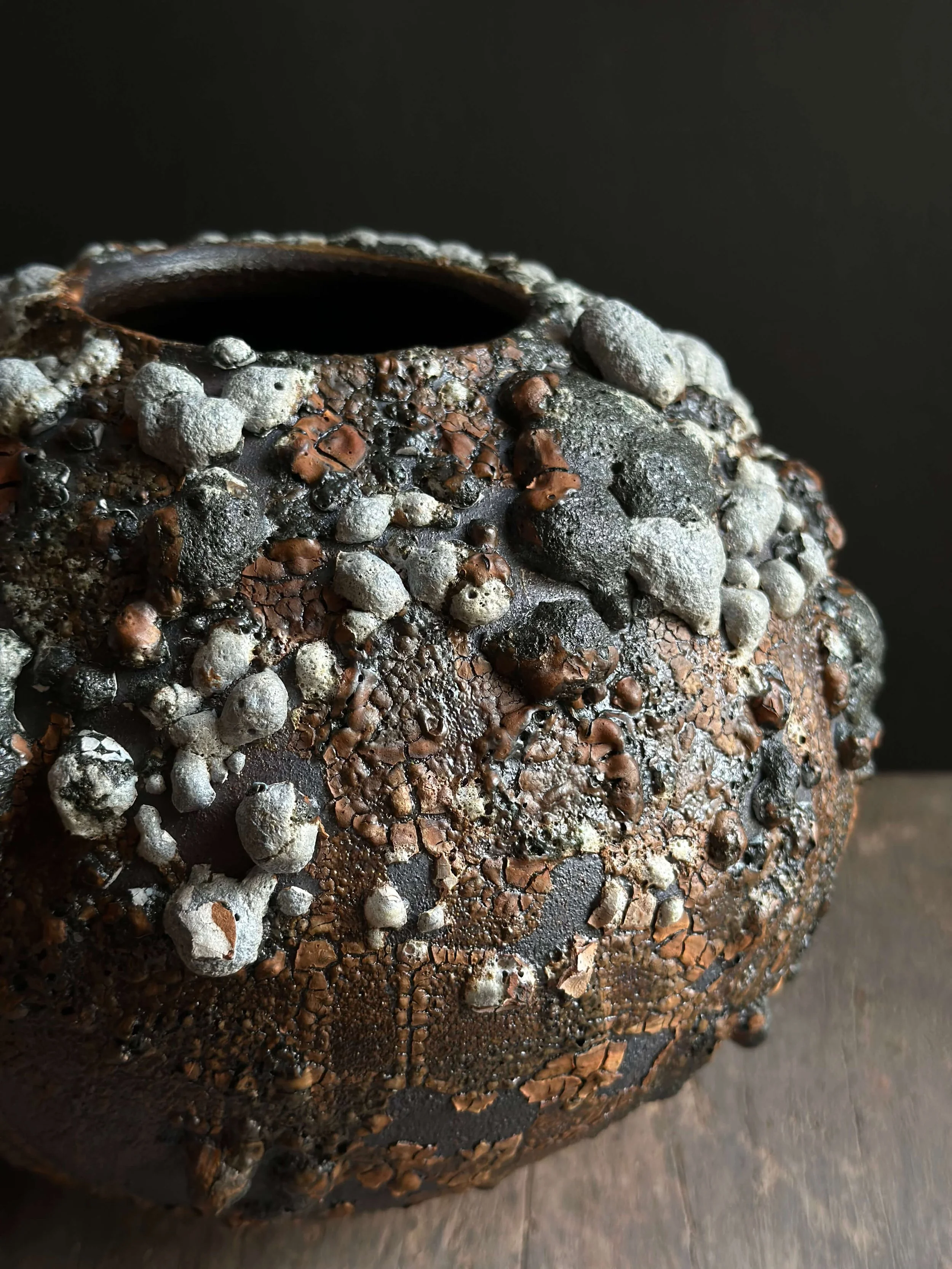
Ceramic textured vessel by Maria Loram
These are decorative glaze surfaces — not functional ones. Crawl glazes and underfired special effect glazes are porous and not food-safe. But for decorative ceramics — sculptures, textured ceramic vases, wall pieces, wabi-sabi pottery, art objects with organic pottery surfaces — they open up territory that a well-fired glossy glaze never reaches.
The earthy, nature-inspired ceramic aesthetic that so many makers are drawn to right now — rough surfaces that look like volcanic rock or weathered stone — often comes from exactly this kind of deliberate underfiring and thick application. It's not an accident. It's a technique.
Want to Learn How to Create Special Effect Glazes?
I don't share full recipes in this post — partly because glaze results depend so much on your specific kiln, clay body, and firing temperature, and partly because I think the method matters more than the recipe.
If you want to go deeper:
The Glaze is Lava is my dedicated online course on lava glaze, crater glaze, and silicon carbide-based special effect glazes. It covers the variables that change results — SiC mesh size, flux ratios, application, troubleshooting — so you understand why glazes behave the way they do, not just what to mix.
Textures in Ceramics is a broader 8-week online course covering ceramic texture techniques from natural materials (slips, rocks, sand, combustibles) through to textured and lava glazes. It's the right starting point if you want to develop a whole vocabulary of ceramic surface decoration.
And if you're specifically after glaze recipes and test results — including my monthly experiments — I post those on my Patreon.
What textures are you experimenting with right now? I'd love to know — send me an email or find me on Instagram.
About the Author
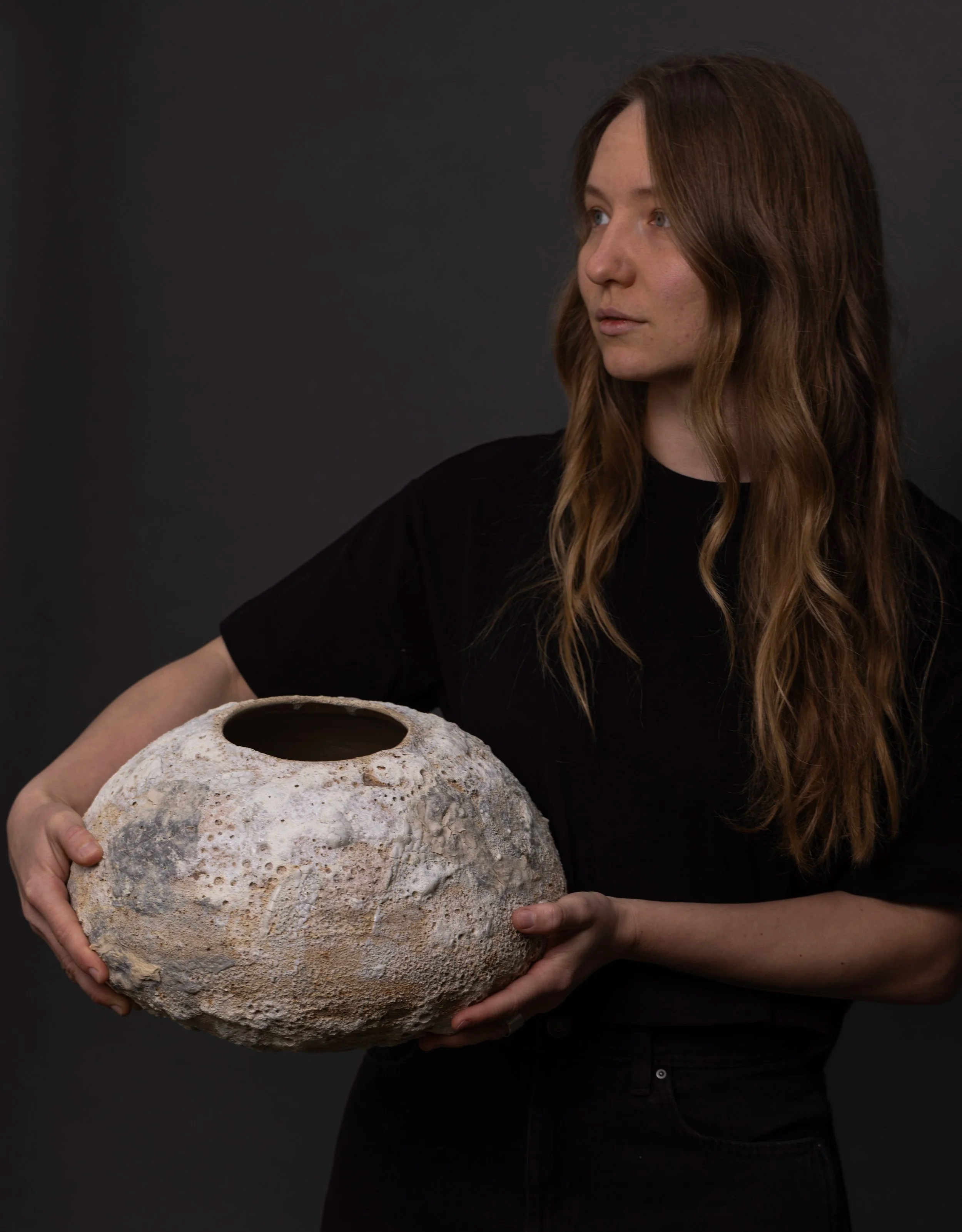
Hi, I’m Maria — a ceramic artist based in the US. I make sculptural lighting and hand-built vessels, and I share my studio process online.
I teach ceramics internationally and online. → loramceramics.com
This checklist is part of a growing library of free guides for ceramic artists and makers.